This guide shows you exactly how to figure out how long until 1:55, whether you mean 1:55 AM or 1:55 PM. You will find the math behind it, ready-made example tables, and answers to the questions people ask most often about this exact time.
Somebody glances at the clock, sees a meeting, a flight, or a show starting at 1:55, and needs a fast answer. That is what this article gives you. No filler, just the numbers and the logic you need.
Quick Answer
The time left until 1:55 depends entirely on what time it is right now. Since 1:55 happens twice a day (once in the morning, once in the afternoon), the countdown changes based on two things: your current time, and whether you mean 1:55 AM or 1:55 PM.
Here is the simple version:
- If it is currently before 1:55 AM, subtract your current time from 1:55 AM.
- If it is currently between 1:55 AM and 1:55 PM, subtract your current time from 1:55 PM.
- If it is currently after 1:55 PM, you add the hours left in the day plus the hours from midnight to 1:55 AM tomorrow.
The rest of this guide breaks each scenario down with real numbers so you never have to guess.
Why People Search “How Long Until 1:55”
This is a more common search than it looks. People typing this into Google are usually in one of these situations:
- Waiting on an appointment or class that starts at 1:55, and they want a rough countdown without doing mental math.
- Tracking a flight, train, or bus departure scheduled for 1:55 AM or PM.
- Checking a live event or stream start time, like a webinar or sports match kicking off at 1:55.
- Curiosity about odd-looking times. A time like 1:55 sits five minutes before a clean hour mark, so it tends to stick in people’s heads.
- Setting an alarm or reminder and wanting to know the gap before it goes off.
Whatever the reason, the underlying question is always the same: how many hours and minutes stand between right now and that specific clock time.
How to Calculate Time Until 1:55
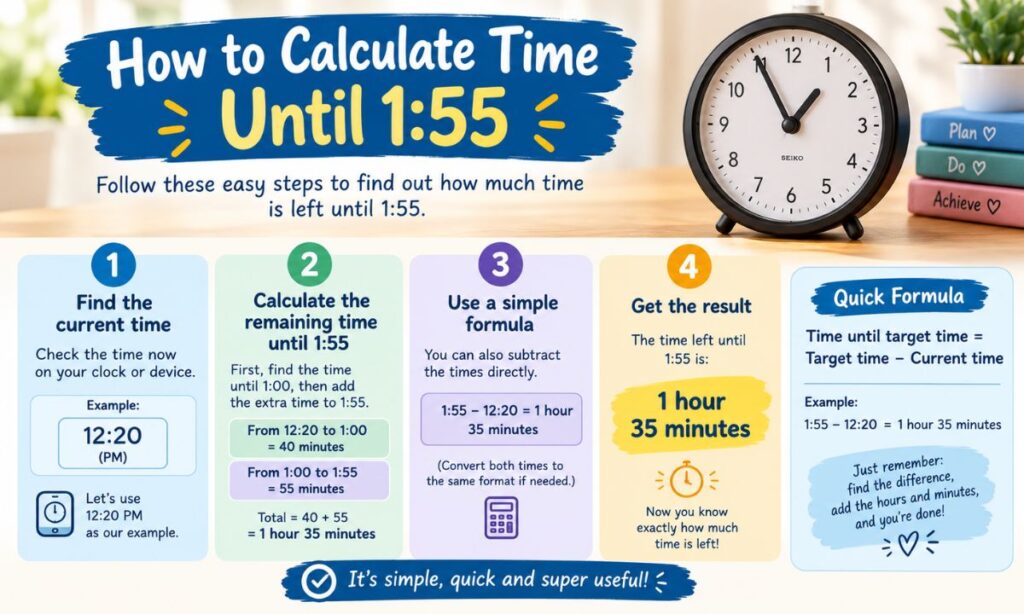
Here is the manual method, broken into steps you can follow with any starting time.
Step 1: Confirm AM or PM
Decide whether you are counting toward 1:55 AM (just after midnight) or 1:55 PM (early afternoon, 13:55 in 24-hour time). This single choice changes the entire calculation, so lock it in first.
Step 2: Convert Both Times to 24-Hour Format
Working in 24-hour format removes AM/PM confusion completely.
- 1:55 AM becomes 01:55
- 1:55 PM becomes 13:55
Convert your current time the same way. For example, 9:40 PM becomes 21:40.
Step 3: Subtract Current Time From Target Time
If the target time is later in the day than your current time, subtract directly:
Target time minus current time = time remaining
Example: Target is 13:55, current time is 10:20. 13:55 minus 10:20 equals 3 hours and 35 minutes.
Step 4: Handle the Overnight Case
If the target time has already passed for the day, you are counting toward tomorrow’s occurrence. Add the remaining hours until midnight, then add the hours from midnight to the target time.
Example: Current time is 22:10 (10:10 PM), target is 01:55 tomorrow. From 22:10 to 24:00 is 1 hour 50 minutes. From 00:00 to 01:55 is 1 hour 55 minutes. Total: 3 hours 45 minutes.
Step 5: Double-Check With Minutes
For extra accuracy, convert everything into total minutes since midnight, subtract, then convert the result back into hours and minutes. This avoids small errors when the minute values do not line up evenly.
1:55 PM in total minutes: (13 x 60) + 55 = 835 minutes since midnight. If it is currently 12:30 PM, that is (12 x 60) + 30 = 750 minutes since midnight. 835 minus 750 equals 85 minutes, which is 1 hour and 25 minutes.
Countdown Table: Time Until 1:55 PM
Use this table as a quick reference if you are counting toward 1:55 PM (13:55) today.
| Current Time | Time Until 1:55 PM |
| 6:00 AM | 7 hours 55 minutes |
| 8:30 AM | 5 hours 25 minutes |
| 10:00 AM | 3 hours 55 minutes |
| 11:15 AM | 2 hours 40 minutes |
| 12:00 PM | 1 hour 55 minutes |
| 1:00 PM | 55 minutes |
| 1:30 PM | 25 minutes |
| 1:50 PM | 5 minutes |
Countdown Table: Time Until 1:55 AM
Use this table if you are counting toward 1:55 AM, the early morning occurrence of this time.
| Current Time | Time Until 1:55 AM |
| 6:00 PM | 7 hours 55 minutes |
| 8:00 PM | 5 hours 55 minutes |
| 10:30 PM | 3 hours 25 minutes |
| 11:45 PM | 2 hours 10 minutes |
| 12:00 AM | 1 hour 55 minutes |
| 1:00 AM | 55 minutes |
| 1:40 AM | 15 minutes |
| 1:53 AM | 2 minutes |
Real-World Application Scenarios
Numbers on a table only help so much until you see them applied. Here are a few situations where knowing the countdown to 1:55 actually matters.
Catching a Flight or Train
Departure boards often list odd times like 1:55 because schedules are built around turnaround windows, not round numbers. If your boarding pass says 1:55 PM departure and you are checking in at 11:40 AM, you have roughly 2 hours 15 minutes before wheels up, and airlines usually want you at the gate well before that.
Joining a Scheduled Call or Webinar
Meeting links sometimes go live at unusual times like 1:55 PM specifically so attendees settle in before the official 2:00 PM start. If it is currently 1:20 PM, you have about 35 minutes to wrap up whatever you are doing and log in.
Setting a Nap or Sleep Alarm
If you are aiming to wake at 1:55 AM for an early shift or a long drive and it is currently 10:15 PM, you are looking at roughly 3 hours 40 minutes of rest, which matters when deciding whether a short nap is worth it.
Cooking or Timer-Based Tasks
Some recipes or lab procedures specify oddly precise end times when they are calculated backward from a serving deadline. If a dish needs to come out at 1:55 PM and it is noon, you have 1 hour 55 minutes to prep and cook.
Working Out Your Own Custom Countdown
If your current time is not listed in either table above, you can still get an exact answer using the total-minutes method from Step 5. Write down the target time in minutes since midnight, write down your current time in minutes since midnight, then subtract. This works for literally any pair of clock times, not just 1:55, so it is worth remembering as a general tool rather than a one-time trick.
For a slightly faster shortcut, count in chunks of five. Since 1:55 sits five minutes before a clean hour, you can often estimate quickly by counting hours to the next round number, then adding or subtracting five minutes depending on direction. It will not replace exact math for something like a flight departure, but it is fast enough for casual planning.
Common Mistakes and Misconceptions
A few errors show up again and again when people try to calculate this manually.
- Mixing up AM and PM. This is the single biggest source of wrong answers. Always confirm which 1:55 you actually mean before doing any math.
- Forgetting the overnight rollover. If the target time already passed today, you have to count into tomorrow, not treat it as a negative number.
- Rounding minutes incorrectly. Sixty minutes make an hour, not one hundred. Adding 45 minutes and 30 minutes gives you 1 hour 15 minutes, not 1 hour 75 minutes.
- Ignoring time zones. If you are comparing your local time to a schedule listed in a different zone, such as a flight departure or an online event, convert both times into the same zone first.
- Assuming digital clocks handle it for you. Most phone clocks show the current time but will not calculate a countdown automatically unless you use a timer or countdown app.
Related Calculations and Topics
If this kind of question is useful to you, these related time calculations tend to come up in the same context:
- How long until 2:00, since 1:55 sits five minutes before this common target time.
- How long until midnight, useful for anyone tracking the AM version of 1:55.
- How long until noon, which helps when calculating the PM version starting from a morning reference point.
- Elapsed time calculators, for figuring out how much time has passed since a past event rather than counting toward a future one.
- Time zone converters, when the 1:55 in question is not in your own local zone.
A Note on Precision for Time-Sensitive Plans
For casual use, rounding to the nearest five minutes is fine. But for anything with real consequences, like catching a train or joining a proctored exam, work with exact minutes rather than rough estimates. A countdown that says “about two hours” can hide a difference of ten or fifteen minutes once you round it back out, and that gap matters more than it seems when you are already running close to the deadline. Setting a phone alarm for the precise target time, rather than trusting mental math under pressure, removes that risk entirely.
Conclusion
Figuring out how long until 1:55 comes down to one decision: AM or PM. Once that is settled, it is basic subtraction using 24-hour format, with a small adjustment if the time has already passed for the day. The tables above give you a fast reference for the most common starting points, and the step-by-step method covers anything not already listed. Whether you are catching a flight, joining a call, or just curious, you now have everything needed to get the exact answer in seconds.
Frequently Asked Questions
How do I know if 1:55 means AM or PM?
Check the context of what you are counting toward, such as a ticket, schedule, or invite. If no context is given, assume the nearest upcoming occurrence, whether that falls in the morning or afternoon.
Is there an easy way to calculate this without doing math?
Yes, any phone or computer countdown timer app lets you enter a target time and it will calculate the remaining hours and minutes automatically.
Why do schedules use odd times like 1:55 instead of 2:00?
Odd times like 1:55 are often set as buffer periods, giving people five minutes to settle in before a call, class, or event officially begins at a round number.
What if it is already past 1:55 today?
You count toward the next occurrence, which is either later today (if you meant PM and it is now afternoon) or tomorrow morning (if you meant AM and it is now past 1:55 AM).
Does daylight saving time affect this countdown?
Only on the specific days when clocks shift forward or back. On a normal day, the countdown to 1:55 works exactly as described, with no adjustment needed.

Pastor John is the dedicated author behind PopularNamesBio.com, a platform focused on delivering engaging and informative content about trending names, celebrity bios, and modern internet culture.